
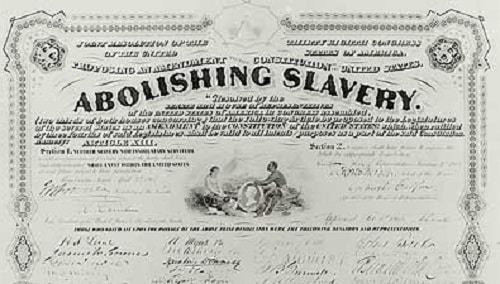
 On Feb. 1, 1865, Illinois became the first state to ratify the 13th Amendment of the Constitution, which officially ended slavery and involuntary servitude.
As the Civil War drew to a close and a Confederate surrender seemed increasingly likely, President Lincoln was determined to use the opportunity to put a permanent end to slavery in the United States. This was no easy feat, and Lincoln expended a significant amount of his political capital to do so. It was his home state of Illinois that backed the president first, with the General Assembly voting to adopt the amendment by a large majority.
In order to propose a constitutional amendment, both the House and the Senate have to approve a resolution to amend the Constitution by a two-thirds majority. Then the proposal goes to the state legislatures to ratify. In order for an amendment to become law, three-fourths of the state legislatures must approve it.
The amendment was not formally adopted until Dec. 6, 1865, when Georgia became the 27th of 36 states to ratify the amendment. Lincoln had been assassinated in April earlier that year.
The amendment was drafted in Alton by Senator Lyman Trumbull, who chaired the Senate Judiciary Committee and was an old friend of President Lincoln.
The 13th Amendment wasn’t the first step toward ending slavery. President Lincoln issued the Emancipation Proclamation on Jan. 1, 1863, freeing slaves across the south. The Emancipation Proclamation was an executive order and was issued during the Civil War as a war measure to suppress rebellion in non-Union states. The 13th Amendment solidified freedom from slavery and indentured servitude once the Civil War ended.